Fall Flash Sale! Get 15% off all languages when you buy 10 hours or more.

CLICK HERE

We made using the Peace Corps Basic Mandinka Course with Cultural Notes material easier to use and more effective. You can now read the ebook (in the pane on the left), listen to the audio (pane to the right) and practice your pronunciation (use on the Pronunciation Tool tab on right) all at the same time.

The Peace Corps Basic Mandinka Course with Cultural Notes material can be used both as a self-guided course or with the assistance of a qualified tutor.

NOTE: Some of these ebooks are quite large and may take a minute to fully load.

Pronunciation tool

NOTE: To read the file, listen to the audios and use the pronunciation tab on your computer or device you need to have a PDF reader and a modern browser.

Currently there are no audios and no videos available for this course.

If you have the missing media for this course please contact support@livelingua.com so we can make them available to everybody.
79 Pages of Free Lessons
2679 KBs of Free Material
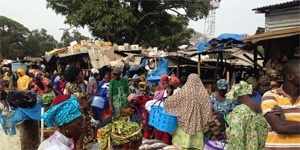
Peace Corps Basic Mandinka Course with Cultural Notes - Image COURSE OVERVIEW
This basic Mandinka course consists of a. series of dialogues with drills, questions, and improvised situations based on the real life experiences of Peace Corps volunteers in the Gambia. The teaching method is structured around choral repetition, backward build-up for difficult sequences, individual repetition, precise explanations of vocabulary, and dictation. There are some grammatical. explanations, although the major emphasis is on proficiency in oral' communication. Substitution, transformation, and expansion drills follow the dictation. students are also required to improvise' situations in which they create their own dialogues and make the` best use of their vocabulary. There is a concerted attempt to integrate language and cultural factors in each lesson, and tills is to be reinforced by role-playing activities and field trips. The basic objectives of the course .include an understanding of Gambian culture, and effective use of language in accomplishing basic daily living tasks.

PROGRAMS THAT USED THIS LANGUAGE
The Gambia: 1967-present
Mali: 1971-present
Sierra Leone:1962-1994, 2010-present
Chad:1966-1979, 1987-1990, 1990-1998, 2003-2006; Currently Inactive

PROGRAM SECTORS
The Gambia: Education, Health, Environment
Mali: Education, Environment, Agriculture, Health, Business
Sierra Leone:Education, Environment, Agriculture, Health
Chad: Currently Inactive
The Mandinka language (Mandi'nka kango), or Manding, is a Mandé language spoken by the Mandinka people of Mali, Senegal, the Gambia, Guinea, Ivory Coast, Burkina Faso, Sierra Leone, Liberia, and Guinea-Bissau and Chad; it is the main language of the Gambia. It belongs to the Manding branch of Mandé, and is thus fairly similar to Bambara and Maninka or Malinké. In a majority of areas, it is tonal language with two tones: low and high, although the particular variety spoken in the Gambia and Senegal is non-tonal and uses a pitch accent.

Latin and Arabic script-based alphabets are widely used for Mandinka; the former is official, but the latter is more widely used and older. In addition, the pan-Mandé writing system, the N'Ko alphabet, invented in 1949, is often used in north east Guinea, and bordering communities in Ivory Coast and Mali. 
Mandinka is spoken in: Gambia, Guinea Bissau, Senegal
Mandinka is also called: Mandé, Mande, Manding, Mandinga, Mandingo, Mandingue, Mandinque, Socé

Downloads

To download any of the files below to your default download location, just click on the link.
To download the link to a specific location, right-click on the link of the file you want to download. A menu should appear on your screen when you do. From that menu select "Save Link As..." (the exact wording can vary depending on your browser or operating system).

Audios

No Audios Available

Videos

No Videos Available